
History of Mount Dora
Mount Dora Timeline
The 1840s to 1860s
The 1870s
The 1880s
The 1890s
The 1920s
The 1950s
The 1980s
The 1900s
The 1910s
The 1930s
The 1940s
The 1960s
The 1970s
The 1990s
The 2000s
1840s to1860s
1842 - The foundation for encouraging settlement in Florida is strengthened with the passage of the Florida Armed Occupation Act in 1842. The “head of the family” would receive 160 acres in return for protection against renewed hostilities with the Indians, enclosure of at least five acres of land, and a commitment to live on that land for five years.
1845 - Florida achieved statehood as the nation’s 27th state. The federal government took note that the region south of the Florida panhandle was a wilderness ready to be tamed.
1846 - Lake Dora may have received its name in this year, perhaps from surveyor C.C. Tracy.
1850s - The Drawdy family, including Dora, her second husband William, a grandmother, and their children moved from Irwin County, Georgia, close to the area that would become Mount Dora.
1866 - The passage of the Southern Homestead Act of 1866 gave thousands of veterans, tenant farmers, sharecroppers, and former slaves the opportunity for fresh starts. Settlers were required to live on the land and improve it for five years, then they would acquire full ownership of 160 acres.
1870s
1870s - James Simpson was the first white child to be born in the area, one of David and Mary’s brood of ten children. Nancy Page settled in the Mount Dora area, having been enslaved three times. She was able to acquire property in the 1880s, 1894 in the downtown area, and 1901.
1874 - David M. Simpson and his wife Mary Vann Simpson and their children became the first homesteaders in the Mount Dora area.
1875 - Clark and Helen McDonald moved to the Mount Dora area from Toledo, Ohio. With them was their daughter Annie, her husband William Stone, and their daughter.
1879 - John P. (J.P.) Donnelly arrived from Pittsburgh, Pennsylvania, just as Annie McDonald Stone was in the process of divorcing William Stone, who had left her in 1877. Former slave Nelson Williams and his wife Cynthia arrived from Island Pond, Florida and welcomed seven children into their family
1880s
1880 - The local settlers were successful in petitioning for a post office. Ross Tremain was the first postmaster.
1881 - Annie and J.P. married. Historians have acknowledged Annie and J.P. Donnelly as Mount Dora’s first “power couple.”
- The Ross Tremain family arrived from Blue Earth, Missouri, by way of Eustis. They purchased a 65-acre parcel of land from David
Simpson.
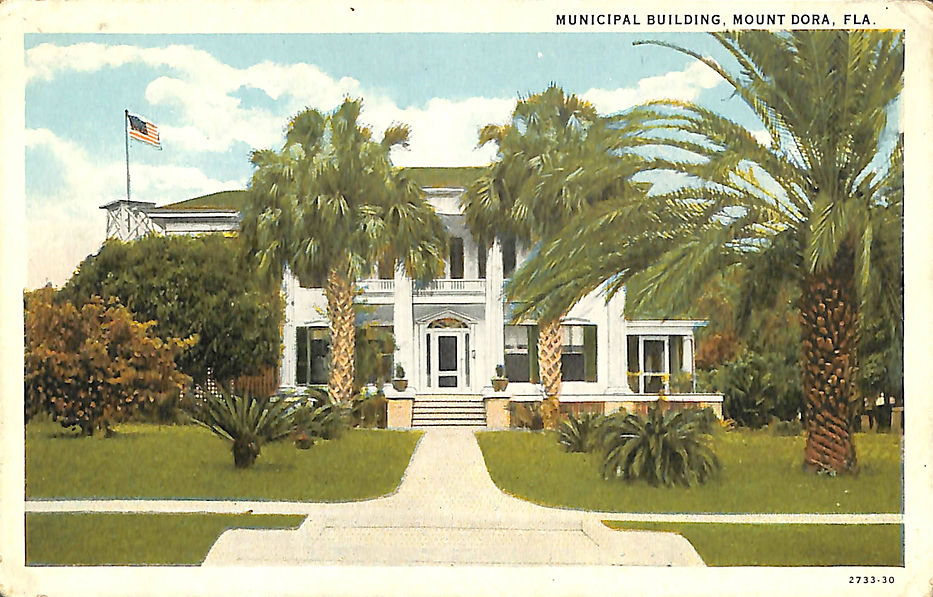
- Reverend Henry and Anna Guller received a homestead in 1881 and built a home on the present site of City Hall. Rev. Guller was the
first pastor of the Methodist Church in Mount Dora. The residence was later purchased by Enoch J. and Mary E. Tompkins. They
modified the building for use as a hotel, adding distinctive colonial columns and renaming it the “Colonial House.”
- The town was named “Royellou,” a combination of the names of three of Ross and Georgia Tremain’s children, Roy, Ella, and Louis.
- On September 17, Public School District No. 59 was established, and the town had its first school shortly thereafter. The school’s first
teacher was 16-year-old Edith Gates, daughter of settler Horatio Gates. The school was available to Black children only when the white
children were not using it.
1882 - Fred and Nellie Risley arrived, encouraged to settle in the town by Fred’s brother-in-law, Ross Tremain.
- Dr. Calvin Gilbert, his wife Margaret, and their five children settled in Mount Dora.
- The Warburton tragedy: Four members of the Warburton family drowned when their wagon slid into Fiddler’s Pond. They are all buried
in Pine Forest Cemetery.
1883 - The residents decided to choose a different name for their town and adopted the name of Mount Dora on February 12. “Mount” referred
to the rolling hills in the area. John Alexander has been credited with suggesting the name.
- J.P. and Annie Donnelly, John Alexander, and Colonel John McDonald came together in partnership to create the ten-room, two-story
Alexander House, the town’s first hotel, on the shores of Lake Dora.
- The Congregational Church was established – the church is the oldest building in Mount Dora.
1884 - Dr. Orin W. and Emma Sadler settled in Mount Dora.
- Black congregants began holding services as St. Mary’s Baptist, on 5th Avenue and McDonald Street, an “arbor church.” They built a
permanent structure in 1892.
1885 - A Methodist congregation began holding services in its newly constructed church.
1886 - From January 10 to January 12, freezing temperatures killed orange trees and other fruit trees. It even snowed on January 12,
according to the diary entry of pioneer C.H. Longstreet.
- The first issue of the Mount Dora Voice went to press. Unfortunately, the newspaper closed after only a few months of operation.
- Dr. Gilbert advertised his new water taxi service, featuring the steamer Dispatch, in the Mount Dora Voice.
- By 1886, visitors could stay at the Bruce House, the Robert Burns House, and the Guller House in addition to the Alexander Hotel.
- J.P. and Annie Donnelly set aside 2.5 acres of land they owned to establish a public cemetery on north Donnelly Street named Forest
Cemetery.
- A separate, one-room schoolhouse for Black children opened. They used the same physical building as white students (the corner of
Clayton and 7th Avenue), but could not attend at the same time.
- By this date, Mount Dora had two general stories, one drugstore, a carriage factory, three hotels, and two churches.
1887 - April 5-14 marked the first season of the South Florida Chautauqua, held in Mount Dora.
- On May 27, 1887, the new Lake County was created by carving 1,157 square miles from Orange and Sumter counties. Mount Dora was
now part of Lake County.
- The Sanford and Lake Eustis Railroad began stopping in Mount Dora on its way to Tavares.
- The Congregational Church was completed on Donnelly Street and 7th Avenue. The church is still standing and holding services.
1888 - The Hotel Chautauqua was built in Mount Dora to house the growing numbers of attendees to the Chautauqua, held from 1887 to 1910.
1890 - Wylie C. Corley became the first pastor of Mount Olive African Methodist Episcopal Church and donated land for the congregation’s first
church.
1893 - The Donnellys built their beautiful Queen Anne-style (Steamboat Gothic substyle) residence that has become the iconic landmark of
Mount Dora.
1894 - The Great Freeze of 1894-95 began when a three-day freeze hit the region, from December 28 to December 30. Temperatures dipped
to 17 degrees.
- The Mount Zion Primitive Baptist Church, located where the Old 441 road meets the new 441 highway, was built.
1895 - The Great Freeze continued when, during the night of February 7, 1895, many of the mature citrus trees that had survived earlier
freezes succumbed. A number of residents, their crops utterly destroyed, gave up and moved out of Mount Dora. Others, such as O.W.
Sadler, Jr., and James Simpson, decided to tempt fate by purchasing land and replanting.
- Charles Edgerton arrived from Philadelphia.
- During that year’s Chautauqua, Mrs. Emma Sadler produced a presentation titled “Sham Battle of the Blue and the Gray.” Local Civil
War veterans from both sides participated in uniform.
1898 - A bicycle path, constructed with clay, opened from Eustis to Mount Dora to Altamont Springs and Sanford.
1899 - Margaret Lewis established a local branch of the King’s Daughters organization.
1890s
1900s
1900 - Thanks to the efforts of Orin Sadler, Jr., Thomas Washington, and David S. Simpson, telephone service comes to Mount Dora, at first
from Sadler’s orange grove in Lake Ola to Monroe Simpson’s store. Soon approximately three dozen customers were connected,
forming the town’s first communications network.
1903 - The Alexander House was renamed Lakeside Inn by its new owner, Emma Boone.
- The Witherspoon Lodge of Free and Accepted Masons, No. 111, purchased the frame vernacular style building on 1410 North Clayton
Street.
1904 - Emma Sadler launched the Mount Dora Improvement Society.
- Betsy Mather Rogers donated 150 books, mostly history and biography volumes, a collection that was the foundation of Mount Dora’s
library.
- Warren Butts became Mount Dora’s first automobile owner, driving a “Lenawee,” a small car manufactured in Adrian, Michigan.
1905 - The fire of 1905 destroyed the Chautauqua camp along with the auditorium and hotel. The South Florida Chautauqua program ceased
that year.
1907 - A colorized postcard printed that year marked the earliest depiction of Mount Dora’s well-known Boathouse Row.
1910s
1910 - Citizens voted to elect officers and incorporate the town of Mount Dora on March 25, 1910. J.P. Donnelly was elected as the town’s first
mayor, and seven aldermen and a clerk were chosen.
- Businesswoman Gertrude Thorne bought a house on McDonald Street and turned it into a hotel-sanitarium named Villa Dora.
1911 - David S. Simpson was the town’s postmaster from 1911 to 1930.
1912 - Educational Hall, a private school, began offering instruction in 1912, geared to the children of northern families who wintered in Mount
Dora. The school closed in 1923.
- Eustis extended electric power lines to Mount Dora.
1913 - The Mount Dora Yacht Club was established by Henry C. Fuller and other boat owners. It is the oldest inland waterway yacht club in
Florida.
- Monroe V. Simpson became the town’s second mayor.
- The town marshal was given permission and $110 to build a jail and also to buy a badge and a pair of handcuffs.
- The Bank of Mount Dora opened, a branch of a Eustis bank.
1915 - The Atlantic Coast Line Railroad built a station in Mount Dora for passenger service.
- J.H. Crane became Mount Dora’s third mayor.
- Alfred Rehbaum opened a hardware store at Donnelly Street and 4th Avenue.
- By this year, a school existed for Black children in East Town.
1916 - The Mount Dora Topic began publishing as the city’s newspaper. H.M. Tallmadge was the publisher and Morgan H. Hoyt was the editor.
- A Masonic Lodge was chartered in this year.
1917 - The library’s collection moved to Educational Hall.
- Dr. O.W. Sadler became the town’s fourth mayor.
- The City Council enacted a health ordinance to set forth sanitary conditions and practices expected of all residents.
- The Primitive Baptist Church was built on Hatchett at Grant Avenue. Rev. Gilbert was the pastor.
1918 - The Mount Dora Citrus Growers Association was established.
- Mount Dora did not experience any deaths from the virulent “Spanish Flu.”
1919 - The Mount Dora Development Club was established by Robert N. “Bob” White and other businessmen.
- James W. Simpson helped organize the local branch of the Florida Citrus Exchange, which would become the Mount Dora Grower’s
Cooperative.
- The Mount Dora Woman’s Club was established.
1920s
The Mount Dora Commercial Club was established, which later became the town’s chamber of commerce.
Black families gradually moved, or were forced to move, to East Town, just outside of Mount Dora as part of the Mount Dora Redevelopment Project.
1919 - The Noonday Club, comprised of Mount Dora civic leaders, was established.
1920 - Mount Dora began to provide its citizens with water from a well at the south end of Donnelly Street, pumped from there to an overhead
tank and then through cast iron mains.
- Harry Wise, a boat builder from Minnesota, opened Wise Boat Works on the shores of Lake Dora.
- Hamp Jackson, right-hand man to J.P. Donnelly, bought the first house in East Town’s Donnelly Subdivision. Donnelly later named
Jackson Avenue in honor of Hamp.
- Several people from Ocoee fled to Mount Dora to seek shelter in the wooded areas in East Town from the white mobs that had burned
buildings and killed Black citizens in Ocoee – the “Ocoee Massacre.”
1921 - Adam Hazelwood became Mount Dora’s fifth mayor.
- The Mount Dora Public School was built to house grades 1 to 12. It was the only school campus in Florida built in the Prairie Style. It
was later renamed in honor of Daniel Douglas Roseborough, one of its first teachers.
- The Mount Dora Band began to play in 1921. It became an orchestra in 1925, but disbanded in 1930.
1922 - Fire destroyed the city’s one-room segregated school for Black children and also burned down much of the east side of Donnelly Street.
After the fire, the children met in the Witherspoon Lodge on North Clayton Street until 1926.
- Earl Gilbert, son of Dr. Calvin Gilbert, donated five acres of land on the shore of Lake Dora that became known as Gilbert Park.
- Monroe Patterson, a successful pottery manufacturer from Liverpool, Ohio, built the Mount Dora Hotel on the west side of Donnelly
Street.
- Edith Edeburn bought the Mount Dora Topic.
- Baptists organized a congregation in Mount Dora, moving into their new church building in 1939.
Mamie Lee Gilbert and Tilmon Thomas founded the Helping Hands Club, with the purpose of assisting local families in need.
1923 - Mount Dora bought the electric power distribution system from Eustis and thereafter obtained electricity from Florida Public Service Co.
- By order of the city council, free-range chickens were no longer allowed within the Mount Dora city limits.
- A.J. Waltz became the town’s sixth mayor.
- A young black man was killed following a “salt-and-pepper” dance on north Grandview Street.
- A firehouse was built on the alley just east of Donnelly Street – now Royellou Lane.
1924 - Inventor and investor Louis R. Heim invested several hundred thousand dollars beginning in 1924 to develop the Sylvan Shores area, a
community of lovely lakeside homes. His dream of completing the development was interrupted by the Great Depression.
- At the urging of the Mount Dora Woman’s Club, J.P. Donnelly sold the land directly across from his home on Donnelly Street to the city.
It was named in memory of Annie Donnelly, J.P. Donnelly’s wife.
1925 - The Bank of Mount Dora and Trust Company was chartered in September.
- The Simpson Hotel opened on 5th Avenue next to the new bank building. Designed by architect James Gamble Rogers II, It was
famous for being totally fireproof.
- The Noonday Club started by Mr. Bob White became the Kiwanis Club.
1926 - Through philanthropy from Julius Rosenwald and Civil War veteran/Presbyterian minister Duncan Milner, a new, four-room school was
built for Black children: Milner-Rosenwald Academy.
- Charles Edgerton and other investors purchased Lakeside Inn in 1926.
- A small hospital opened north of Lake Gertrude.
- Residential mail delivery began.
1927 - D.C. Sherman became Mount Dora’s seventh mayor.
- The Bank of Mount Dora and Trust Company achieved national bank status and changed its name to the First National Bank of Mount
Dora.
1928 - The Mount Dora Bowling Club was established.
- Mattie Gamble received her midwifery license, after years of careful instruction from the local general practitioner, Dr. Finn. She was the
first certified midwife in Mount Dora.
- Milner-Rosenwald Academy fielded its first basketball team.
1929 - The Mount Dora Community Building opened and became the center for the city’s events and activities.
- Shuffleboard came to Mount Dora, first played on courts in Donnelly Park. The game would become very popular with local residents as
the years progressed.
1930s
1930 - Former president Calvin Coolidge and his wife, Mrs. Grace Coolidge, visited Mount Dora for a month in January and stayed at the
Lakeside Inn. Mrs. Coolidge participated in the dedication of the new Community Building.
- Wells E. Lackey became the town’s eighth mayor.
- The town’s high school fielded a football team for the first time.
1931 - The Florida Gas Company laid gas lines in Mount Dora for heating and cooking.
1932 - George L. Hanscom became Mount Dora’s ninth mayor.
- Louis R. Heim gave funds to Mount Dora to erect a line of streetlights, a “white way,” from downtown to Sylvan Shores.
1933 - Monroe V. Simpson became the town’s tenth mayor.
1936 - Around this year, Mama’s Place, run by Eunice Johnson, began operating on Grant Avenue. It joined a barber shop, Tod Goggins
Drugstore and Ice Cream Shop, and The Blue Moon Café. The café was an important gathering place for the leaders of East Town, who
would convene and discuss topics of importance to the neighborhood.
1938 - Cauley O. Lott became principal of the Milner-Rosenwald Academy and held that role until 1970, when the schools were integrated.
- The Mount Dora Lions Club received its charter.
1940s
1940 - The 1940 census counted 1,880 residents in Mount Dora.
1941 - On May 29, a Mount Dora Topic article encouraged every man, woman, and child over the age of 15 to attend a “National Defense
Mass Meeting” that evening to discuss what they could do in case the U.S. went to war.
- The Reverend Norman R. McNair arrived to lead the Mount Olive A.M.E. congregation at Pine and Grandview.
- The town’s firemen, at that time all volunteers, occupied a new firehouse on 4th Avenue west of Donnelly, and the police began using a
desk there as a station.
1942 - In response to a concern about air raids, Mount Dora mounted an aircraft observation station on top of the Simpson Hotel on 5th
Avenue.
1945 - A post-war real estate boom began and lasted into the 1950s, with Mount Dora becoming popular as a place not only to live, but also to
do business.
1946 - J.E. Fortner became Mount Dora’s 11th mayor.
- Rev. Norman R. McNair organized the Bethel Free Methodist Church.
1947 - Air conditioning arrived in Mount Dora, first in the cocktail lounge of the Sylvan Shores Hotel. Other businesses added air conditioning
not long after, including the First National Bank and Sally’s Dress Shop.
- Edith Edeburn and husband George Keller sold the weekly Mount Dora Topic to Paul and Mabel Norris Reese of Akron, Ohio. Their
proprietorship of the newspaper lasted until 1960.
- Mamie Lee Gilbert was elected president of the Lake County Chapter of the NAACP.
1948 - In September, a group of live theater aficionados formed the Icehouse Players. They held their premiere in 1949 with Return
Engagement.
1949 - The tragic story of the Groveland Four began with a false accusation. One of the four men accused was killed by a posse of law officers
that included the Lake County sheriff. The three remaining accused were convicted in a trial that garnered national attention; they finally
were exonerated in 2021 by a Lake County circuit court judge.
- A portion of Rev. Norman McNair’s Mount Olive congregation built a new church, the Bethel Free Methodist, at Jackson and Tremain
streets.
1950s
1950 - D. Fletcher Crane became the town’s 12th mayor.
1951- Lake County Sheriff Willis McCall shot two of the remaining Groveland Four while they were being transported, killing one and badly wounding the other.
1952 - Lou L. Heaton became Mount Dora’s 13th mayor.
1953 - The town of Mount Dora became a city, officially.
- A group of interested citizens established the Mount Dora Historical Society.
- Led by Mrs. Ouida Heist and Mrs. Marie Edgerton, a group of 28 women founded the Lakes and Hills Garden Club.
- Black residents began work on their own community center in East Town. It was renamed the Martin Luther King, Jr., Center in 1989.
- Mount Dora’s Forest Cemetery was renamed Pine Forest Cemetery to honor the lovely pine trees on the property.
1954 - The saga of the Platt family began, when Sheriff McCall believed the Platt children to be Black rather than of Irish-Indian descent and
would not allow them to attend the school for while children. In 1955, a circuit court decided that the children were white and could go to
the Mount Dora school.
- In August 1954, the Ku Klux Klan visited East Town, where they held a cross-burning. They also burned a cross on Mabel Norris Reese’s
yard, defaced the Mount Dora Topic’s windows, and poisoned Ms. Reese’s dog.
- The town’s Rotary Club was established.
- A pool for white residents and their guests opened.
- A new school for Black children, bearing the Milner-Rosenwald name, opened in the fall at Grant Avenue and Rhodes Street. Mr. Cauley
Lott was the principal.
- The Mount Dora Yacht Club began staging sailing regattas.
1955 - Several critics of Mabel Norris Reese and the Mount Dora Topic established a rival weekly newspaper, the Mount Dora Herald. The
paper folded in April 1956.
1956 - W.D. Patton became the town’s 14th mayor.
- A public pool for Black residents and guests opened near the Milner-Rosenwald Academy.
1959 - Mount Dora became the model for the small town of Fort Repose in Pat Frank’s apocalyptic novel, Alas Babylon. Frank lived in nearby
Tangerine.
1960s
The Mount Dora Catacombs were built, a secret underground sanctuary where as many as 100 people could live for at least six months in case of a nuclear attack. Twenty-five wealthy families pitched in $2,000 each.
1960 - Guy C. Bliss became Mount Dora’s 15th mayor.
- The Story of Mount Dora, authored by Ruper Longstreet with contributions from other residents, was published by the Mount Dora
Historical Society.
1961 - Margaret Lofroos, daughter of Bob White, became the first female president of the city council.
- The Golden Triangle Shopping Center was completed, as was the new route for Highway 441 that bypassed the city.
1962 - Jesse D. Willmott became the town’s 16th mayor.
- The Mount Dora area experienced another hard freeze in December, killing more than 50 percent of Lake County’s citrus trees and
dropping production in half by 1964.
1964 - The new City Hall, located on the rise overlooking Donnelly Park, was dedicated in April.
1965 - A few Black youngsters entered Mount Dora elementary and high schools as the area reluctantly began desegregation efforts.
1966 - A fire destroyed the Mount Dora Yacht Club’s clubhouse. It was subsequently rebuilt.
- Roland Willis and Gwendloyn Ellis were the first Black graduates from Mount Dora High School.
- Cauley Lott reimagined the abandoned Milner-Rosenwald Academy building into a day care center and a branch of the Mount Dora
Public Library.
1970s
The city’s tradition of an annual Christmas parade began, first supported by the Jaycees and later by the Lions Club.
1970 - Mrs. Ralph Harbert and others established the Friends of the Library.
- The Mount Dora School Board changed the name of Milner-Rosenwald Academy to Mount Dora Middle School. It was the first school
year for all Mount Dora students in the 6th, 7th, and 8th grades.
1971 - Carroll Griggs was the first fire chief appointed by the city government.
- A new marina opened on Charles Avenue, managed by Tom Shipes and Paul Herrlinger.
1972 - The Mount Dora Community Trust began operations, established by retirees Mr. and Mrs. Lawrence Williams.
1973 - In May, St. Patrick’s Roman Catholic Church was dedicated.
1974 - The Mount Dora Bicycle Festival had its first run.
- Thomas R. Champion became Mount Dora’s 17th mayor.
1975 - The historic Donnelly House, now owned and occupied by Lodge No. 238 of the Fraternal and Accepted Masons, was named to the
National Register of Historic Places on April 4, 1975.
- The Mount Dora Arts Festival was held for the first time, sponsored by the Mount Dora Center for the Arts. It has been a popular annual
event ever since, attracting around 200,000 visitors each year.
1976 - A new main branch of the library was built on the corner of Donnelly Street and 9th Avenue and was dedicated in July and November
1977.
- The inlet of Lake Dora next to Gilbert Park was named Simpson Cove, after the city’s pioneer family.
1977 - Jefferson G. Ray became the town’s 18th mayor.
- Frank Clifton was selected as Mount Dora’s first city manager, a position that had grown out of the city administrator’s functions.
1978 - In January, Margaret Lofroos was sworn in as Mount Dora’s 19th – and first female – mayor.
- James Simpson, the first white child born in Mount Dora, celebrated his 100th birthday.
- Sandra Chavous opened the first full service, upscale beauty salon in downtown Mount Dora. The shop “Chavous” served all races.
1979 - Bill Farmer became the city’s second city manager, a position he would hold until May 1984.
1980s
A series of freezes killed most of the citrus trees in the area.
1980 - Gordon Dake became the town’s 20th mayor.
1981 - The feature film, Honky Tonk Freeway, was released, in which Mount Dora played the fictional town of Ticlaw that wanted a highway exit
to attract visitors. Part of the downtown area was painted pink. The movie did not receive rave reviews and upset many residents.
- Faye Hill Brooks was the first Black woman elected to the Mount Dora City Council.
1982 - Lieutenant Earl Gooden became the first Black policeman to lead the Mount Dora Police Department.
1983 - William O. Boyd became Mount Dora’s 21st mayor.
1984 - Renninger’s Twin Markets opened on 117 acres on Highway 441. This secured Mount Dora’s reputation as the “Antique Capital of
Central Florida.”
- Tony Segreto was selected as Mount Dora’s third city manager.
1985 - The Mount Dora Craft Festival was held for the first time, an initiative of two downtown merchants.
1986 - The Mount Dora Register of Historic Buildings was established.
1987 - The Lakeside Inn was added to the National Register of Historic Places.
- Jeff Book became the town’s 22nd mayor.
- A lighthouse was erected at the tip of the point in Gilbert Park. It is the only lighthouse on an inland lake in Florida and is one of the city’s
most photographed spots.
1988 - The Mount Dora City Council appointed a board to run the Community Redevelopment Agency (CRA), which would manage the Mount
Dora Redevelopment Plan, designed to reinvigorate the downtown area.
1989 - In January 1989, Billy Osborne created the Mount Dora Civic Enhancement Association.
- Dennis Finch became the city’s fourth city manager.
1990s
1990 - Robert Wilson became Mount Dora’s 23rd mayor.
- Lighthouse Walk along Simpson Cove was dedicated on July 4.
- The Northeast Community Redevelopment Agency was established, with a goal to improve the area in alignment with the Mount Dora
CRA.
- Mount Dora became a sister city to Forres, Scotland.
1991 - Paulette Alexander became the town’s 24th mayor. (Dale Cunningham is city manager during this time.)
1992 - The Mount Dora train station was placed on the National Register of Historic Places. Passenger service to Mount Dora had ceased in
1950, and freight cars made their last run in 1973.
- The County Club of Mount Dora was dedicated, featuring a golf course and 800 homes.
- The Simpson House, originally located at 4th Avenue and Tremain Street was moved to its new, permanent home in front of the Goat
Pond on Donnelly Street.
1993 - The “Storm of the Century” hit Mount Dora on the evening of March 13, 1993. The storm, which spawned several small tornados in the
Mount Dora area, topped around 500 oak trees, destroyed a dozen homes, damaged 250 others, and killed three.
- Mount Dora established the Historic Preservation Board in March.
- Bernice Brinson became Mount Dora’s city manager.
- The fire and police departments relocated to a new building at the corner of Donnelly Street and Lincoln Avenue.
1994 - A special issue of Money Magazine listed Mount Dora as the third best location for retirement in the country.
1995 - The library, now known as the W.T. Bland Library, moved to its current home on Donnelly Street next to the Goat Pond.
1996 - The Mount Dora Growers Cooperative closed after losing many member and suffering significant financial losses.
- The Land Development Code was passed by the Mount Dora City Council. The Code included sections on zoning, site plans, design
standards, and architectural standards.
1998 - Mount Dora’s first music festival debuted, promoted by classical musician Jennifer Reed and British musician Anthony Hose. In 2001,
the event’s name changed to the Mount Dora Festival of Music and Literature.
2000s
2000 - James E. Yatsuk became Mount Dora’s 25th mayor.
2007 - Melissa DeMarco became the town’s 26th mayor
2009 - Mount Dora was added to the National Register of Historic Places as a historic district, covering roughly 3rd Avenue to 11th Avenue and Clayton Street to Helen Street.
2011 - Robert Thielhelm, Sr., became Mount Dora’s 27th mayor.
2013 - Catherine T. Hoescht became the town’s 28th mayor. She would serve in that role again from 2019 to 2021.
2015 - Nick Girone became Mount Dora’s 29th mayor.
2021 - Chrissy Stile became the 31st mayor of Mount Dora.
- Patrick Comiskey became city manager.
2024 - James Homich became Mount Dora’s 32nd mayor. He also is president of the City Council.
- Vince Sandersfeld was appointed as city manager.
- The Forest Preserve opened in May. Located behind the W.T. Bland Public Library, the interactive outdoor space is dedicated to
preserving and restoring the urban forest for future generations.